Why Short Videos Are the Perfect Trap for the ADHD Brain — and Why They Can Make Neurotypical People Lose Their Attention
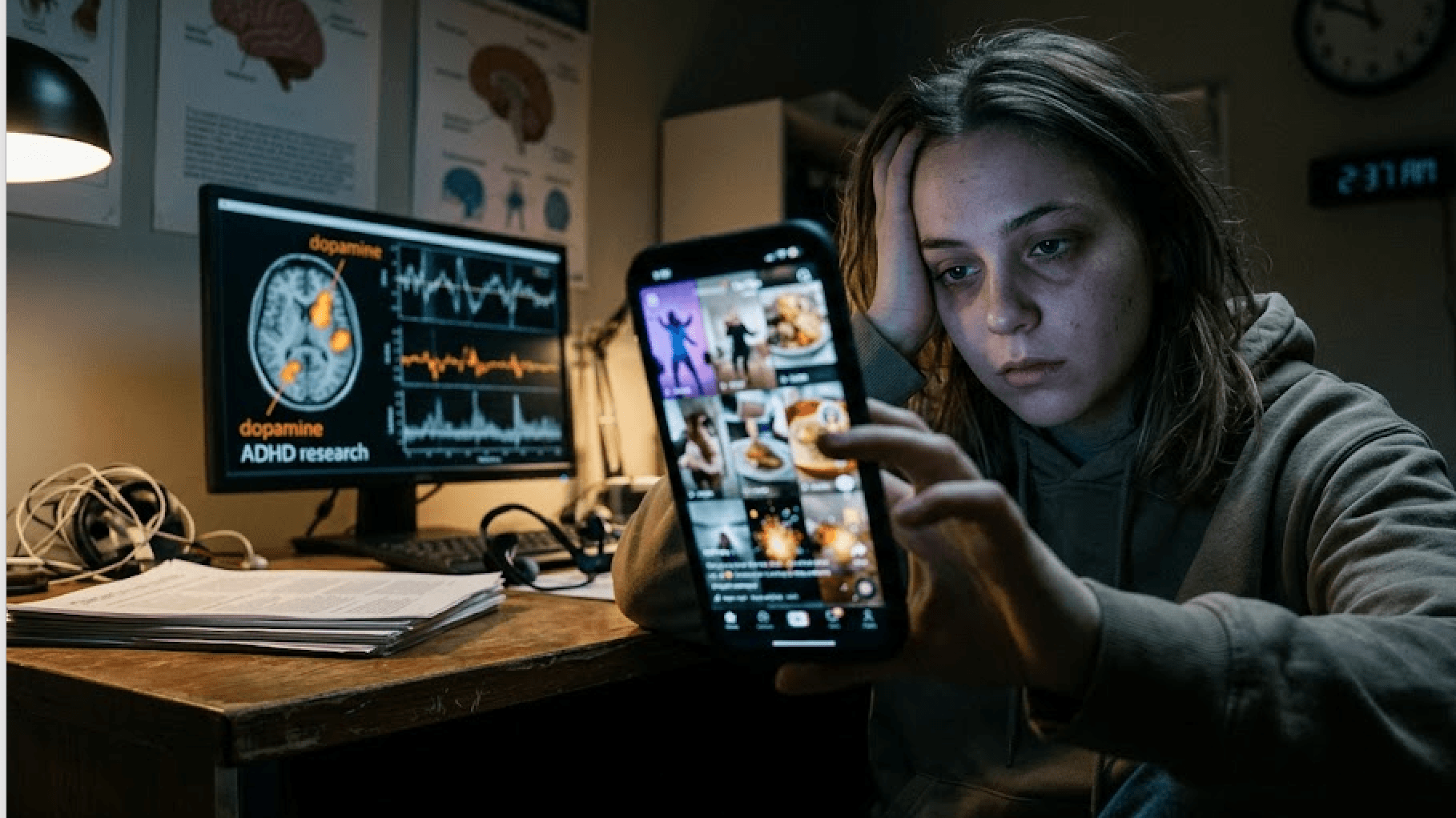
You are sitting on the couch. Maybe on the toilet. Maybe in bed at eleven at night, even though at nine you told yourself, “just five more minutes.” Your thumb moves upward almost by itself, without any conscious command. A fifteen-second pasta recipe you will never actually cook. Swipe. A guy explaining geopolitics in a way that makes your blood pressure rise. Swipe. A cute kitten falling off a shelf. Swipe. An influencer who irritates you for some reason, yet you still watch her video all the way to the end.
This ritual has a name. It is called infinite scrolling, and if you have just told yourself that it does not apply to you, I have some unpleasant news: you are probably wrong.
This is not harmless entertainment. It is an experiment on your brain.
Look, nobody here is going to moralize with the usual “put your phone down and go for a walk.” The world does not work that way, and people quite reasonably ignore advice like that. But there is something else we cannot ignore: the growing body of research examining what happens to our attention, reward processing and emotional regulation when we repeatedly consume rapidly changing digital content.
Short-form video formats such as TikTok, Instagram Reels, YouTube Shorts and anything operating on the same principle are not simply digital entertainment. They are products of sophisticated recommendation systems designed to keep users engaged for as long as possible.
For most people — those neuroscience generally describes as neurotypical — this can mean gradually developing habits that make sustained attention, emotional regulation and deep thinking more difficult. For people with ADHD, it may be even more problematic. For them, these platforms can provide an unusually powerful source of immediate stimulation.
So let's look at why that might be the case. And let's look at it properly, because this concerns practically everyone who has a smartphone in their hand.
The slot machine in your pocket
To understand what happens when you open TikTok or Reels, you first need to understand one thing about the human brain that is often misunderstood.
Dopamine is not simply the “happiness hormone.” That is an oversimplification that has been repeated so often that it has become a pseudo-truth. Dopamine is deeply involved in motivation, learning, reward prediction and anticipation. Research shows that dopamine signalling can increase when the brain anticipates a potentially rewarding outcome — particularly when the outcome is uncertain.
Now put that into the context of what you are doing when you scroll.
Every swipe across the screen is essentially a tiny gamble. You do not know what comes next. Maybe it will be a completely boring video that you skip within a second. Maybe it will be something that makes you laugh out loud. Maybe it will be something that annoys you enough to leave a comment. You do not know — and that uncertainty is part of the mechanism.
In psychology, this is related to the concept of a variable reinforcement schedule. The concept was extensively studied by American behavioral psychologist B. F. Skinner in the twentieth century. Skinner found that when animals received reinforcement for pressing a lever, but not after every press — sometimes yes, sometimes no, in an unpredictable pattern — they could continue responding persistently.
Do you know where this principle is used particularly effectively? In gambling. Slot machines operate around unpredictable rewards. A player usually loses, occasionally wins something small, and very rarely wins something substantial. That unpredictable pattern can keep people engaged.
And now consider your TikTok feed. It operates according to a similar reinforcement principle. Not by accident, but because recommendation algorithms are designed to optimize engagement. If every video on your feed were equally predictable and rewarding, the experience would become less stimulating. Instead, the system continually searches for content that is likely to keep you watching.
The result? Your brain remains in a state of anticipation:
“What if the next one is even better?”
“What if the next video is the best one I've ever seen?”
And so you keep scrolling.
And scrolling.
And scrolling.
Researchers from Zhejiang University have investigated how personalized short-video recommendations engage reward-related brain networks. In one fMRI study, researchers observed activity associated with personalized video recommendations, including regions involved in reward and motivation. The findings provide evidence that personalized short-form video content can engage neural systems involved in reward processing.
Your brain is therefore repeatedly exposed to fast-changing, potentially rewarding stimuli. No waiting. No significant effort. Just swipe, swipe, swipe — and another potentially rewarding piece of content appears.
Why the ADHD brain can become trapped
Now imagine that you are a person with ADHD.
We are not talking about someone who occasionally procrastinates or forgets where they put their keys. We are talking about a person with a neurodevelopmental disorder involving persistent difficulties with attention regulation, impulse control and executive functioning.
ADHD is not simply an inability to concentrate. It is more accurately understood as a difficulty regulating attention. A person with ADHD can absolutely concentrate. The problem is that controlling what they focus on, when they focus on it and for how long can be much more difficult.
When something is sufficiently stimulating, a person with ADHD may become intensely absorbed in it — a phenomenon often described as hyperfocus. But when a task is boring, repetitive or offers no immediate reward, initiating and sustaining it can become much harder.
Now take this brain, which is often highly motivated by novelty and immediate stimulation, and put a platform such as TikTok in front of it.
What happens?
The brain has found an extremely efficient source of stimulation.
All those things a person with ADHD may struggle with every day — planning, self-control, delaying gratification and initiating tasks — suddenly become unnecessary. The algorithm does the cognitive work for them.
It selects the content.
It cuts it into perfectly sized pieces.
It delivers novelty and emotion at regular intervals.
The user does not have to do anything except lie there and consume it.
For an ADHD brain, it can feel like finding a well in the middle of a desert.
The problem is that the water does not necessarily satisfy the underlying thirst.
Research published in psychiatric and behavioral-science journals has associated problematic short-form video use with difficulties involving attention, self-control and other psychological outcomes. The relationship is complex, however, and much of the evidence is correlational rather than proof that short videos directly cause ADHD symptoms.
The immediate relief that some people with ADHD experience while scrolling can therefore become part of a cycle of executive dysfunction. And the cycle can look something like this:
A person with ADHD opens TikTok.
They become absorbed in the stream of stimulating content.
Time disappears.
An hour passes. Two. Sometimes three.
And eventually, for whatever reason, they close the app.
This is where another problem can appear.
People sometimes describe what follows as a “dopamine crash” — a dramatic drop in dopamine below their normal baseline. That description is popular online, but it is important to be precise: there is not good evidence that ordinary short-form video use causes a measurable dopamine level to crash below baseline in the way this phrase suggests.
What many people do experience is something much more familiar: a sudden transition from extremely high stimulation to an ordinary environment.
And ordinary life can suddenly feel painfully slow.
Cleaning.
Work.
School.
Eating.
Getting dressed.
Answering messages.
Everything seems boring compared with the endless stream of novelty that was just available.
For someone with ADHD, this transition can feel especially difficult because executive-function demands were already challenging before the scrolling began.
People in the ADHD community sometimes call this ADHD freeze — a state in which initiating even simple actions can feel almost impossible.
It is not necessarily that the person does not want to act.
The problem may be that the brain is struggling to transition from a highly stimulating environment into a low-stimulation task that requires sustained effort.
And it is not only about motivation.
Working memory also matters. Working memory is the system that allows us to temporarily hold information and intentions in mind while we act on them. When attention is repeatedly interrupted, it becomes easier to lose track of what we intended to do.
You forget to take your medication.
You forget that you were supposed to call the doctor at four.
You forget about tomorrow's deadline.
You forget something you clearly remembered an hour earlier.
Not because you do not care.
Because your attention has been repeatedly redirected.
For people with ADHD, excessive short-form video consumption is therefore not necessarily harmless entertainment. It can become a behavior that provides immediate stimulation while potentially making the transition back to less stimulating tasks even harder.
The “Pseudo-ADHD” epidemic — when a healthy brain starts losing its attention
But now we reach perhaps the most concerning part of the story.
These platforms do not only affect people who were born with ADHD. They can also affect people who never had an underlying neurodevelopmental disorder.
Online discussions sometimes use terms such as “digital ADHD” or “Pseudo-ADHD” to describe attention problems associated with excessive digital stimulation. These are not formal medical diagnoses, and they should not be confused with actual ADHD.
There is nevertheless a real phenomenon worth discussing.
The human brain is an incredibly adaptive organ. It possesses a property called neuroplasticity — the ability to change its functional organization and strengthen or weaken neural connections in response to repeated experiences.
That is excellent news when you are learning to play the piano or recovering from a neurological injury.
But it also means that the patterns we repeatedly practice can become easier and more automatic.
If you spend hours every day consuming fifteen-second videos, your brain becomes extremely practiced at processing information in short bursts.
It becomes accustomed to novelty.
To rapid transitions.
To immediate rewards.
To constantly changing stimuli.
That does not mean that the physical structure of your brain has literally been “rewired for fifteen-second attention spans,” but it does mean that repeated behavior can shape attentional habits.
Professor Gloria Mark from the University of California, Irvine, has spent years studying attention and interruptions in digital environments, and her research provides an important perspective on how frequently people switch between digital activities.
Her work has shown that people can spend surprisingly short periods on a single digital activity before switching to something else. However, the exact figures depend heavily on the task, technology and measurement method, and they should not be interpreted as a universal “modern human attention span.”
Still, the broader trend is important.
We are living in an environment where switching is effortless.
You can read a sentence.
Check a notification.
Watch a video.
Reply to a message.
Open Instagram.
Return to the article.
Check the time.
Open TikTok.
And repeat.
Now ask yourself what happens when this highly fragmented attention system is suddenly asked to perform a task requiring prolonged, linear concentration.
You probably know the experience.
You sit down with a book.
You read two pages.
And suddenly you feel an almost irresistible urge to check your phone.
Or drink some water.
Or stand up and look out the window.
It does not necessarily mean that the book is boring.
Your brain has simply become accustomed to a much higher rate of stimulation and switching.
This is one reason why reducing short-form content can make sustained attention feel difficult at first.
A neurotypical person — someone without ADHD — may begin experiencing distractibility, restlessness, difficulty completing long tasks or frustration with low-stimulation activities.
From the outside, some of these experiences can look superficially similar to ADHD.
But that does not mean the person has developed ADHD.
ADHD is a neurodevelopmental disorder. It is not something a person acquires simply because they watched too many TikToks.
And that distinction matters.
Emotional Russian roulette
If you think the effects of short-form video end with attention, there is another aspect worth considering.
Think about what happens to your emotional system during ten minutes of scrolling.
Not theoretically.
Practically.
Try paying attention to it next time.
The first video makes you laugh.
The second bores you, so you skip it.
The third shows a war report and you experience a flash of sadness and helplessness.
The fourth is an influencer on holiday in the Maldives and you feel a flicker of envy.
The fifth is a political commentary that makes your blood boil.
The sixth is a cute kitten and you feel happy.
The seventh is a conspiracy theory and you feel angry.
And so on.
This is an unusually rapid succession of emotional stimuli.
Human beings evolved in environments where emotional reactions were generally tied to events that unfolded over longer periods of time. Modern feeds can compress dozens of emotionally charged stimuli into just a few minutes.
What we are doing while scrolling can therefore resemble emotional Russian roulette — constantly switching between radically different emotional states at a pace our nervous system did not evolve specifically for.
Research published in journals such as Computers in Human Behavior has found associations between problematic or excessive short-form video use and various psychological outcomes, including emotional difficulties and problematic behavior. However, these studies generally cannot establish that short videos alone directly cause those outcomes.
One possible mechanism involves repeated emotional stimulation and rapid attentional switching.
The amygdala is a brain structure involved in processing emotionally significant information, particularly threat and fear. It does not mean that every emotional video sends your body into a full stress response, but repeatedly exposing yourself to highly arousing content can keep your attention focused on emotionally salient stimuli.
Stress-related physiological responses can also occur in response to emotionally demanding experiences.
You are not necessarily in panic.
You are not necessarily frightened.
You may simply feel...
tense.
Restless.
Overstimulated.
Irritable.
And you may not even know why.
Then you put your phone down.
And your nervous system has to transition back to ordinary life.
Your partner asks an innocent question:
“Do you want to go for a walk?”
Or:
“What should we have for dinner?”
And you react with disproportionate irritation.
You snap.
You become impatient.
You get annoyed over something trivial.
And you wonder why, because you were “just watching videos.”
But your brain has just spent an extended period processing a continuous stream of novelty and emotionally salient information.
Self-diagnosis through TikTok
As if all of this were not complicated enough, there is another particularly important issue — and it directly concerns ADHD.
ADHD-related content is extremely popular on TikTok and other social-media platforms.
The problem is that many of the people creating this content are not psychiatrists, psychologists or neuroscientists.
They are content creators.
And content that produces recognition, surprise or emotional engagement is often more likely to attract views.
The scientific literature has also examined the quality of ADHD-related TikTok content.
A study published in the Canadian Journal of Psychiatry systematically analyzed popular TikTok videos about ADHD and found substantial amounts of content that was misleading or inconsistent with established diagnostic information.
The important point is not that every ADHD creator is spreading misinformation.
It is that social media is not a diagnostic tool.
Creators may say:
“If you procrastinate when cleaning, you have ADHD.”
“If you sometimes forget why you walked into the kitchen, you have ADHD.”
“If you hate boring tasks, you have ADHD.”
“If your desk is messy, you have ADHD.”
These statements describe experiences that can occur in practically anyone.
Who has never had a messy desk?
Who has never forgotten why they walked into a room?
Who has never procrastinated?
ADHD is not “I sometimes forget where I put my keys.”
ADHD is a neurodevelopmental disorder involving persistent symptoms that begin in childhood, occur across relevant settings and cause clinically significant impairment.
People with ADHD may struggle with school, work, relationships, deadlines, finances, organization and maintaining routines despite making substantial efforts.
And now there is a growing population of neurotypical people who may interpret ordinary experiences through the lens of ADHD because of highly relatable social-media content.
Some may then seek professional assessment.
That is not necessarily a bad thing.
In fact, there is an important positive side to ADHD content online.
Many people with ADHD — particularly adults who were overlooked during childhood — may have never considered ADHD as an explanation for their lifelong difficulties. Accurate educational content can help them recognize patterns and encourage them to seek professional assessment.
That is valuable.
But recognizing yourself in an online video is not the same as receiving a diagnosis.
And that distinction is crucial.
At the same time, we should not put every ADHD creator in the same category. There is a significant difference between content based on scientific and medical evidence and content designed primarily to generate views.
Social media can help spread awareness.
It can also spread misinformation.
Both things can be true at the same time.
Is there a way out? (Yes, but you probably won't like it)
Here is the good news.
And it really is good news, although it comes with one unpleasant condition.
The key difference between ADHD and attention problems associated with excessive digital stimulation is reversibility.
If you take a person with ADHD and remove technology from their environment, their ADHD does not disappear.
They will still have the underlying neurodevelopmental condition.
But if a person without ADHD develops poor attentional habits through excessive digital stimulation, those habits can potentially change.
That same neuroplasticity that allows the brain to adapt to repeated patterns also allows us to develop different patterns.
The brain has become accustomed to rapid stimulation?
It can learn to tolerate slower stimulation again.
But it takes time.
And that is the unpleasant part.
You have to reduce the thing your brain has become accustomed to consuming.
The solution is not to return to the Stone Age.
Nobody is telling you to throw your phone into a river.
But a useful approach is what experts often call digital hygiene.
And it can look something like this:
Remove the triggers. Delete apps that are primarily built around endless short-form video feeds from your phone. Completely. Not “move them into a folder I cannot see.” Delete them. If you genuinely need them, access them through a web browser, where the experience may be less frictionless and the endless feed less immediately accessible. Even the extra step of opening a browser, typing an address and logging in can create a small barrier between an impulse and the behavior.
Create artificial barriers. Use tools that limit or block access to social-media applications. Not just reminders telling you that you have been online for an hour. Those are easy to ignore. Use stronger restrictions when necessary. Fifteen or twenty minutes a day may be a reasonable personal limit for some people. The exact number is less important than having a boundary you can actually follow.
Train yourself to tolerate slower rewards. This is one of the most important parts — and also the part where many people give up. Your brain has become accustomed to rapid, immediate stimulation. You can gradually teach it that rewards can arrive later and that delayed rewards can still be satisfying.
Read books.
Not just articles on the internet.
Books.
Physical books, where you have to sit, read and stay with the same material instead of receiving a new stimulus every fifteen seconds.
The first days may feel almost painfully boring.
You read two pages and feel the urge to reach for your phone.
Stay with it.
Over time, sustained attention can become easier.
Playing a musical instrument.
Exercise.
Manual work.
Even something as simple as completing a puzzle or working in a garden.
Anything that requires patience and concentration, where the reward arrives gradually after effort, can help you practice tolerating slower stimulation.
Is it difficult?
Yes.
Is it uncomfortable?
Definitely.
Can attentional habits change?
Yes. That is one of the things we know about neuroplasticity and behavioral learning.
In conclusion: Why should you care?
We live in a time when human attention has become one of the most valuable commodities in the digital economy.
This is not a conspiracy theory.
It is a business model.
Technology companies make money from user attention, and recommendation systems are designed to maximize engagement.
The algorithm is not your friend.
But it is not necessarily your enemy either.
It is a system optimized around measurable engagement, and your attention is the resource being measured.
The ability to maintain focus, resist constant distraction, finish what you started and protect your attention will become increasingly important in modern society.
For neurotypical people, this may affect productivity, learning and personal well-being.
For people with ADHD, managing digital stimulation may be particularly important because their existing difficulties with attention regulation and executive functioning can make highly stimulating environments especially difficult to disengage from.
And the ability to distinguish a genuine neurodevelopmental disorder from attention problems associated with digital overload will remain important for patients, clinicians and society as a whole.
So next time you pick up your phone and your thumb automatically moves toward that familiar icon — stop for one second.
Just one.
And ask yourself:
“Am I doing this because I want to?
Or because I feel like I have to?”
If the answer is not completely clear, that is worth paying attention to.
Because noticing the pattern is the first step toward changing it.
Scientific Sources and Recommended Reading
-
Su, C., Zhou, H., Gong, L., Teng, B., Geng, F., & Hu, Y. (2021). Viewing personalized video clips recommended by TikTok activates default mode network and ventral tegmental area. NeuroImage, 237, 118136. DOI: 10.1016/j.neuroimage.2021.118136
-
Yeung, A. Y., Sturman, S., Sarvode Mothi, S., et al. (2022). TikTok and Attention-Deficit/Hyperactivity Disorder: A Cross-Sectional Study of Social Media Content Quality. Canadian Journal of Psychiatry, 67(12), 899–906. DOI: 10.1177/07067437221082854
-
Mark, G. (2023). Attention Span: A Groundbreaking Way to Restore Balance, Happiness and Productivity. Hanover Square Press. gloriamark.com
-
Sha, P., & Dong, X. (2021). Research on Adolescents Regarding the Indirect Effect of Depression, Anxiety, and Stress between TikTok Use Disorder and Memory Loss. International Journal of Environmental Research and Public Health, 18(16), 8820. DOI: 10.3390/ijerph18168820
-
He, J., Zheng, L., Nie, Y., et al. (2023). Problematic short-form video usage and its associations with psychosocial outcomes: A cross-sectional survey among Chinese college students. Computers in Human Behavior, 142, 107666. DOI: 10.1016/j.chb.2023.107666
-
Barkley, R. A. (2015). Attention-Deficit Hyperactivity Disorder: A Handbook for Diagnosis and Treatment (4th ed.). Guilford Press.
-
Volkow, N. D., Wang, G. J., Kollins, S. H., et al. (2009). Evaluating Dopamine Reward Pathway in ADHD: Clinical Implications. JAMA, 302(10), 1084–1091. DOI: 10.1001/jama.2009.1308
-
Montag, C., Yang, H., & Elhai, J. D. (2021). On the Psychology of TikTok Use: A First Glimpse From Empirical Findings. Frontiers in Public Health, 9, 641673. DOI: 10.3389/fpubh.2021.641673
-
Skinner, B. F. (1957). Schedules of Reinforcement (with C. B. Ferster). Appleton-Century-Crofts.
-
Maza, M. T., Fox, K. A., Kwon, S.-J., et al. (2023). Association of Habitual Checking Behaviors on Social Media With Longitudinal Functional Brain Development. JAMA Pediatrics, 177(2), 160–167. DOI: 10.1001/jamapediatrics.2022.4924
This article is for educational purposes and does not replace an individual assessment by a healthcare professional.
Comments are provided by the external Giscus/GitHub service and load only after your consent.