When ADHD and Depression Meet
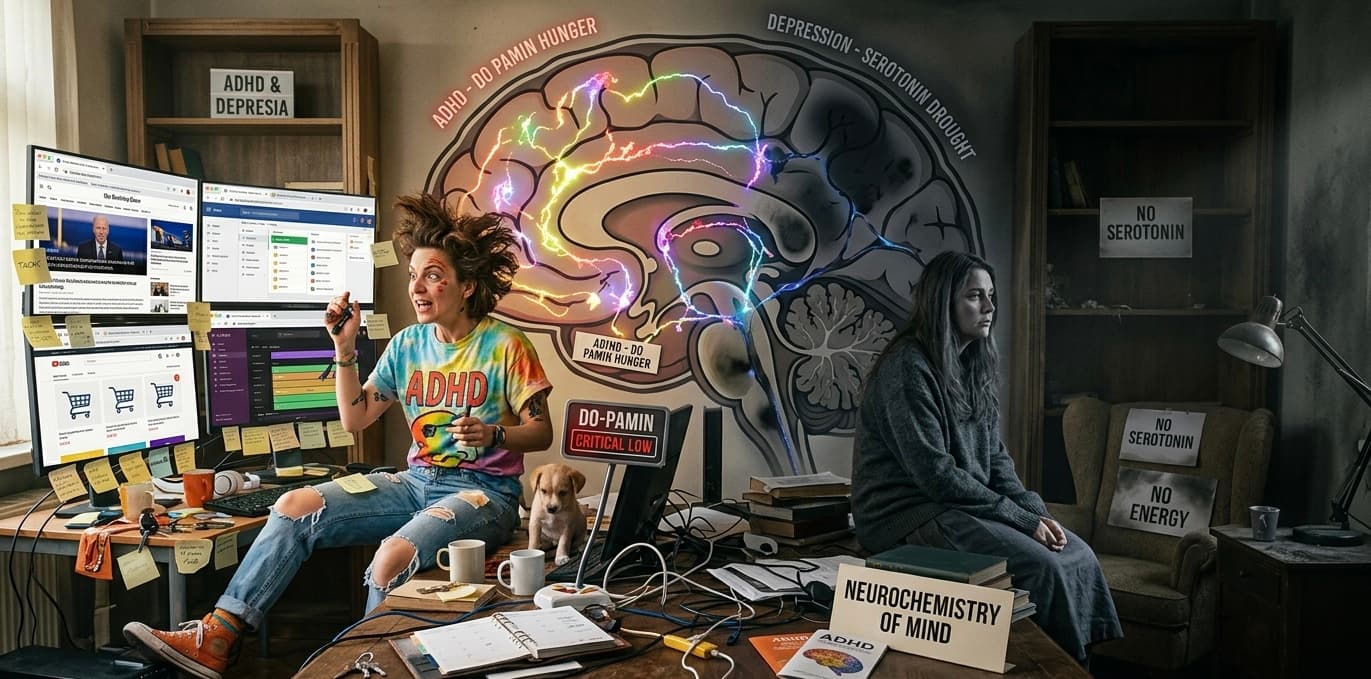
Do you ever feel like your brain is running 47 open browser tabs, with music playing in one that you cannot turn off, three others are shopping for something, and your system keeps flashing a critical error message? Welcome to the world of ADHD.
Now imagine depression crashing into this wild party. It turns off the lights, stops the music, sits down in the corner and says: “None of this matters anyway. Let’s just stare at the wall for three days.”
ADHD and depression are like those two toxic friends you really do not want to see together at a party. Yet they are connected far more closely than you might think. And no, it is not just because it drives you crazy when you cannot find your keys again (although that certainly contributes).
A Neurochemical Blind Date: When the Juice Runs Out
Let’s step into the laboratory for a moment, but I promise it will not be boring. It all revolves around two main characters in your brain: dopamine and serotonin.
The ADHD brain has a permanent lack of dopamine (that is the chemical that says: “Good job, here’s a reward!”). That is why a person with ADHD is constantly looking for new stimulation, from scrolling through social media to impulsively buying things they will never use.
Depression, on the other hand, is associated with low serotonin and an overall feeling that your batteries have completely run out.
When these two conditions come together, they create the perfect storm. The ADHD brain desperately searches for dopamine, while depression takes away all the energy needed to go looking for it.
The result? A person ends up stuck on the couch in a state that researchers sometimes refer to as “ADHD paralysis”, while internally experiencing an existential crisis.
According to scientific studies, adults with ADHD may be up to three times more likely to experience clinical depression. But why is that?
3 Reasons Why ADHD and Depression Often Go Hand in Hand
1. I Want to Be “Normal” – Burnout
Living in a world designed for neurotypical people can be exhausting for someone with ADHD. Imagine spending the entire day masking your symptoms: trying not to interrupt people, trying not to forget deadlines, trying not to mentally drift away in the middle of a conversation, and pretending that you have your life under control.
This constant effort to “keep it together” can lead to enormous psychological exhaustion. And from exhaustion to depression, there may be only a small step.
2. The “I Messed Up Again” Syndrome
When ADHD causes you to forget to pay a bill again, miss an important meeting or fail to finish a project, your inner critic does not start applauding. Instead, guilt and shame take over.
When these small failures happen repeatedly for years, a person can begin to believe that they are incapable. Psychologists refer to this as learned helplessness, which can contribute to the development of depression.
3. Rejection Sensitivity (RSD)
People with ADHD often experience a phenomenon known as RSD (Rejection Sensitive Dysphoria). It refers to intense emotional pain triggered by real or perceived rejection or criticism.
When your boss says, “Can we talk tomorrow?”, a neurotypical person might simply shrug it off. An ADHD brain can immediately start writing a whole scenario about getting fired, becoming homeless and nobody liking you anymore.
This emotional roller coaster can place an enormous burden on the mind.
How Do You Know Who Is Actually Holding the Wheel?
Sometimes it is difficult to tell where ADHD ends and depression begins because they can overlap and mask one another.
| Symptom | Is it ADHD? | Or is it Depression? |
|---|---|---|
| Difficulty starting a task | I want to do it, but my brain does not know how to sequence the steps (paralysis) | I do not care whether I do it or not; nothing feels meaningful (apathy) |
| Sleep problems | I am lying awake at 2 a.m. thinking about the mysteries of the universe and why the dinosaurs went extinct. | I am exhausted but cannot sleep because of the heaviness in my chest — or I sleep 14 hours a day |
| Social isolation | I forgot to reply to messages because I became interested in a new hyperfixation. | I do not want to see anyone because I feel like I am nothing but a burden to everyone. |
What Can You Do About It?
If you feel like both of these unwanted guests are running the show inside your head, we have an important message for you: You are not lazy, incapable or broken. Your brain is simply wired differently.
What Actually Helps?
-
Differential diagnosis: Treating depression without addressing ADHD can be like mopping the floor while the tap is still running. A good psychiatrist understands that in some cases, treating ADHD (for example, by targeting dopamine-related mechanisms) may also improve depressive symptoms.
-
Self-compassion: It sounds like something from a self-help or “woo-woo” guide, but it can work. The next time you forget something, instead of saying “I’m an idiot,” try telling yourself: “Ah, my ADHD is acting up again. Let’s figure this out.”
-
A dopamine menu: Create a list of healthy activities that quickly improve your mood and energy (a short walk, your favourite song, a cold shower) so that you have something to reach for when the darkness starts creeping in.
Living with ADHD and depression can sometimes feel like riding a roller coaster that is missing a few screws. But by understanding how your brain chemistry works, you can turn that wild ride into a much more manageable — and sometimes even enjoyable — road trip.
This article is for educational purposes and does not replace an individual assessment by a healthcare professional.
Comments are provided by the external Giscus/GitHub service and load only after your consent.