Diagnosed After Thirty: Simona’s Story of Hidden ADHD
Diagnosed After Thirty: When Perfectionism Was Just a Mask
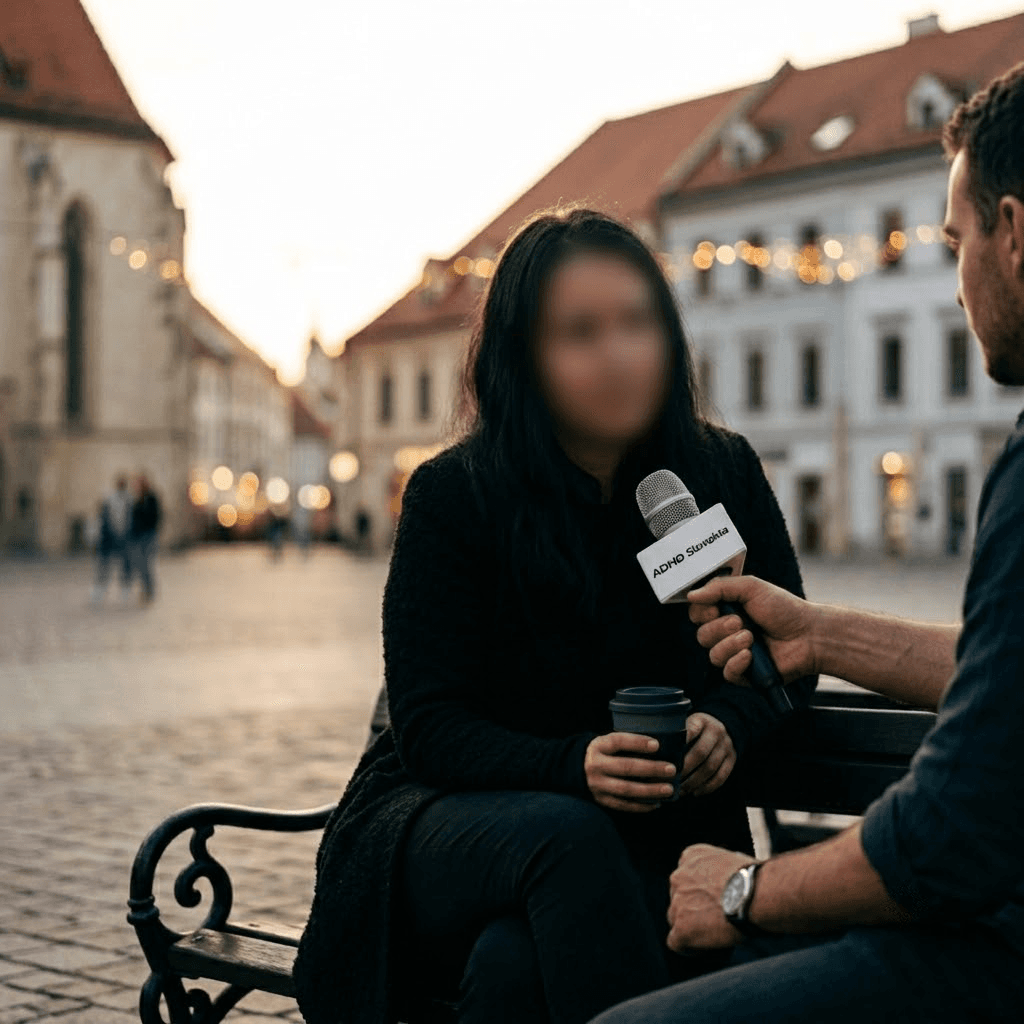
Simona is 39 and works as a lecturer, translator and occasional interpreter. In her free time, you will find her with a book in her hand or engaged in a discussion with friends. She describes herself as a "curious introvert" who loves good coffee, difficult questions and anything that can satisfy her curiosity. For years, however, she quietly carried the feeling that she was "lazy", "incapable" and "disorganized" — until her own psychiatrist said the word that changed everything: ADHD. In an interview with ADHD Slovakia, she talks about a childhood full of masking, her journey towards diagnosis, and why access to treatment in Slovakia remains such a major problem.
Part 1: Childhood
Looking back at your childhood, were there already traits or behaviours that you now clearly attribute to ADHD?
Definitely, yes. But because my ADHD is predominantly inattentive, it was not particularly noticeable when I was very young, and when it did show, it was mostly because I was dreamy. Once I started school, I struggled to focus on things that did not interest me or that moved very slowly for everyone else. On top of that, I was messy at home, very sensitive, disorganized, impatient and extremely picky with food — something that has stayed with me to this day and that I have never really managed to change Even then, though, I was able to mask it at school through excessive perfectionism, which unfortunately clashed quite badly with actually getting tasks finished. I had many interests, but they all stopped being interesting to me the moment I realized they required a lot of time and energy. During puberty, impulsivity, a dislike of authority, rebelliousness and behaviour that was a little "over the top" were added to the mix. My parents would probably have called it cheekiness and arrogance On top of that, nobody really talked about ADHD when I was growing up, so it never occurred to anyone, even when I was struggling.
How did you function at school?
During primary school, everything came very easily to me and I was often bored because the other children seemed slow to me — I understood the material quite quickly. The first years at the eight-year grammar school were still more or less fine, but the later years became much more difficult for me. Mainly because it was a science-focused grammar school, and I struggled with the natural sciences and developed a strong dislike for them, unfortunately also because of the teachers. I did not have a good relationship with them because I rebelled against pointless rules, prohibitions and unnecessary memorization. My mother was convinced that this was the right path for me, but it turned out to be the worst period of my life.
Did you feel that you fit in with your classmates as a child?
It depended. As a child, I sensed that I was somehow different from other children, but not particularly strongly, and I certainly could not put it into words. I also had many friends, and that was crucial for me as a child. Gradually, however, this feeling of "not belonging" became stronger. It was not until university that I fully accepted it, and as part of my rebellious nature, I did not fit into groups all that well — but I did not mind. Being outspoken, lacking tact and having an undiplomatic way of expressing myself did not exactly help with my popularity
What was your favourite subject at school, and which one did you dislike?
I have always liked foreign languages, and even though learning them requires quite a lot of memorization, I learned them relatively quickly. And as I mentioned, the natural sciences were and still are my nightmare. This is also connected to the fact that I had undiagnosed dyscalculia, which was only discovered during my ADHD assessment.
When you think about your childhood, do you have mostly positive memories, or do the negative ones prevail?
Definitely the latter. But that is not only related to ADHD. The circumstances in my family were also far from ideal.
Part 2: The Road to Diagnosis
What was the first moment when you thought that you might have ADHD?
It was definitely some post on Instagram that really resonated with me. After that, I started looking more deeply into what ADHD actually involves. At the same time, I asked my psychiatrist what she thought about it. Fortunately, she is one of the professionals who recognizes this diagnosis and explained to me that many women my age — over thirty — are diagnosed with ADHD even though they had previously been treated for depression, bipolar disorder, anxiety or other disorders.
What was that realization like? Did you feel fear, denial, or relief that everything suddenly made sense?
I felt incredibly curious. I went into what is known as hyperfocus — people with ADHD know exactly what I mean — and started reading and watching absolutely everything I could find. Quite quickly, I discussed it with my psychiatrist and I was already on my way towards an official diagnosis. At the same time, besides curiosity, I felt something like hope. Hope that maybe I was not simply lazy, disorganized or emotionally dysregulated, but that there was something behind it that was not my fault.
What were your main sources of information about ADHD at the time?
Apart from the Instagram post I mentioned, it was primarily international literature and YouTube videos. I was missing Slovak or Czech sources, or rather, at the time they tended to focus more on children and adolescents. So I had to look elsewhere. That was not really a problem, though, because there was already a huge amount of information available, and there is even more today. Nowadays, it is not difficult to find literature in Slovak and Czech either, as demand for information on the subject has increased.
How long did it take from your first suspicion to actually sitting down with a professional?
I was lucky because I got my first appointment within a few weeks. A new psychologist had just joined the psychological diagnostic centre where I was eventually diagnosed, and she had availability to see me very quickly for an initial session.
What was the diagnostic process itself like from your perspective? Was it exhausting, or did you feel that you were finally being heard?
It was much more exhausting than I originally expected. The memory and attention tests themselves were quite demanding, and during the process I already began to understand why I had felt so stressed at school when faced with similar types of tasks. Filling out several questionnaires was also challenging because they were long, and for me it meant going quite deeply into the past and memories that were definitely not pleasant.
How difficult was it to get the correct diagnosis? Did you encounter prejudice, dismissal, or perhaps incorrect diagnoses such as depression or anxiety before ADHD was identified?
I am not sure whether I was incorrectly diagnosed. I suffered from anxiety before my diagnosis, and I still do, although to a much lesser extent. For me, it was not a case of ADHD medication magically making all my symptoms disappear. I wish it had, but it didn't I did not encounter prejudice or dismissal, at least not within the professional psychiatric or psychological community. I know that I was lucky, because there are people who have had a completely different experience from mine. And unfortunately, a much worse one.
What did the entire ADHD diagnostic process look like for you?
As I mentioned, I have a great psychiatrist, and she referred me to a psychological diagnostic centre where she had already sent other people and had good experiences, so I did not have to worry about figuring everything out myself. Logistically, it was also easy. The centre was only a few minutes from where I lived, so I was lucky even in that respect. The first session was a fairly long interview about my medical and personal history. I was given several questionnaires to complete, and one or two were also given to my parents. The second session involved concentration and memory testing, and I think there was something else as well, but I can no longer remember The final session was about evaluating the questionnaires and tests, where we went through the individual results together.
Did you encounter any problems during the diagnosis or when choosing medication? For example, problems with access to treatment?
I did not encounter any problems with the diagnosis itself. Medication is a different story, as there have been several shortages over the past few years. We have always managed to find an alternative, but that should not be the patient's responsibility. Medication should be easily accessible to everyone in Slovakia. Unfortunately, reality is often different.
Part 3: Life With a Diagnosis
When you received official confirmation, what happened inside you? Many people diagnosed later in life experience not only relief but also a sense of grief over what their life might have been like if they had known earlier. Did you experience something similar?
Suddenly, everything fell into place. The secondary feeling was: how is it possible that nobody noticed this before? Not even my therapist, whom I had been seeing for several years. I was a little angry with her, but with time I understood that she cannot be an expert in everything — and that applies not only to her, but to every therapist in the world. On top of that, many ADHD symptoms overlap with symptoms of post-traumatic stress disorder, which was the reason I had been seeing her for therapy. So initially I felt relief, then anger and regret about who I could have been but am not, and where I could have been but am not. And eventually, I came to accept the diagnosis. I cannot say that these thoughts never come back from time to time. But I think it is a very common experience among people with ADHD.
What form of treatment or therapy are you currently undergoing, and what effect has it had on your everyday life?
I am currently switching from Livizux to Concerta. I have taken Concerta in the past, so during the summer I plan to observe how it affects me. I had to stop taking Livizux because of anxiety and headaches. It also has a negative effect on my sleep, regardless of how early in the morning I take it. At the same time, I attend cognitive behavioural therapy (CBT), which can have a positive effect on people with ADHD. I can say with certainty that it does for me, but I am still at the beginning, and this is a long-term process.
What changed for the better after starting treatment?
I am kinder to myself and I no longer constantly criticize myself internally for things that go wrong or that I struggle with. I also have much more respect for both people close to me and strangers who are dealing with similar things, and I am more empathetic. While taking medication, I experienced what it is like to have more energy, to have the capacity to finish things, to stop putting off things I do not enjoy and, I suppose you could say, to function more like a neurotypical person It is a shame that I cannot maintain that state because of the medication's side effects. Not everyone experiences them as strongly as I do, but there is not much I can do about that.
What tools or routines help you maintain balance the most today?
For me, one of the most difficult tasks of all is simply starting something, especially when my brain labels it as boring. I have adopted a piece of advice from my therapist: I do not have to finish the entire task immediately. I can break it down into smaller parts, and doing at least something is enough. I also use the Pomodoro technique, where you choose one task and work on it for 25 minutes without interruptions. During that time, I turn off all sounds on my phone and computer. Then I take a five-minute break. When taking stimulants, I have found that a protein-rich breakfast works well for me. I underestimated this at first, and my stomach did not handle it very well. It also means that I do not get hit by extreme hunger in the evening, and I function more calmly than when I quickly grab something small around lunchtime. I have also learned to keep a small snack and water nearby when I work from home because I often forget to eat and drink. And because I hate getting up in the morning and always keep postponing my alarm for a few minutes, I leave my phone far away from the bed at night so that I have to get up to turn it off. I have also let go of the idea of consistency because it is something that is almost impossible to achieve with ADHD. Instead, I choose flexibility and listen more closely to my body and brain. If I have a lot of energy, I get a lot done. If I am tired or overstimulated, I no longer punish myself for doing nothing. It does not make me any less valuable :)
Many people with ADHD also experience sleep disorders. Is that the case for you? Did this change after starting treatment?
Paradoxically, I do not really have problems with sleep itself. Unless we count the fact that I am a night owl, go to bed late and then struggle to get up in the morning But I do not have problems falling asleep or waking up during the night, apart from when I was taking Livizux, which made it difficult for me to fall asleep. That is no longer an issue.
Part 4: Prejudice and Change
How did people react when you told them about your diagnosis?
So far, I have told only a few people. Even a large part of my family does not know, and I have no plans to change that. Most people were surprised or even shocked because they have this idea of ADHD as something that only affects small, restless and badly behaved boys. And I no longer feel like explaining to everyone around me what it actually involves. Older generations in particular carry a lot of prejudice. My friends sometimes make jokes about it, but essentially very few people understand it, and I do not lose sleep over that :)
Have you encountered prejudice, such as people saying ADHD is made up, that it is simply laziness, or that all you need is willpower?
Of course. I encounter that regularly. People sometimes claim that it is just an excuse, a lack of discipline or even some kind of "intellectual deficiency". When that happens, I usually ask with a smile where they get their information from. Most of the time, it is simply based on personal assumptions, so when it comes to the comment about intelligence, I find it rather amusing internally. I never use my diagnosis as an excuse and I do not treat it as a shield against criticism. I see it more as an explanation for why I do certain things differently. But because it rarely meets with understanding, I have stopped bothering to explain myself. It is exhausting. Anyone who is genuinely interested will ask me themselves or proactively learn something about it — and I deeply appreciate that.
What is the difference between your life before and after your diagnosis? What are the biggest changes you notice?
I see myself differently, I like myself more, I have more compassion for myself and I do not push myself so hard. I am trying to forgive myself. Before my diagnosis, my life was a constant, exhausting battle against myself. Feeling broken, lazy or incapable takes an incredible amount of energy. I would constantly blame myself for every failure or unfinished project. I lived under permanent stress, worrying that someone would "discover" that I could not keep up or handle things the way everyone else seemed to. But I still have to live in a world designed for neurotypical people. No diagnosis will change that. Nevertheless, we can choose environments that suit us and even jobs — although this certainly does not apply one hundred percent of the time — where we can avoid neurotypical demands such as accounting or routinely filling out spreadsheets
Part 5: A Message to Others
What do you think should change in Slovakia when it comes to ADHD diagnosis or treatment?
Access. And I say that as someone who was extremely lucky throughout the whole process. But I see much more complicated stories around me. It starts with psychiatrists themselves — some refuse to accept that ADHD genuinely exists in adults and are unwilling to educate themselves about it. I do not understand how it is possible that there are still so many doctors within the professional community with this attitude. If I were to be very strict, I would say that it raises questions about whether they are even fit to practise their profession. Because of this, people have to travel to other cities for diagnosis. And even when they find one, they run into a huge financial barrier. My psychiatrist also works in a hospital, but in her private practice she does not have contracts with health insurance companies. So I pay for every appointment myself, roughly once every month and a half. Then you have to add the cost of medication. For example, Livizux costs around €63 per month, plus other treatment, plus the doctor's fee in Bratislava... Sometimes I genuinely feel like I work just to pay for my mental health. The diagnosis itself is another chapter. I have come across private clinics in Bratislava that charge €600 or even €800 for it. That is simply outrageous. I had mine done for a fraction of that amount, also at a non-state facility. So I cannot help feeling that some "clever" entrepreneurs have simply spotted a great business opportunity at the expense of desperate people who need help.
There are still many half-truths and myths about ADHD around the world. How would you describe people's awareness of ADHD today?
Awareness of ADHD has improved significantly in recent years, especially thanks to social media and a more open dialogue about mental health, but we are still only halfway there. One disadvantage, however, may be that there is almost "too much information" in some circles, if that is even the right way to put it. Many people think they have ADHD because they see one-minute videos on social media listing various symptoms. This probably applies more to younger generations, who are more present on social media and therefore more influenced by its content. It regularly happens that people ten, fifteen or even twenty years younger than me tell me that they also have ADHD. When I ask whether they have an official diagnosis, I always get the same answer — "I saw it on Instagram, TikTok, etc." Another thing that often surprises me is the glorification of the disorder and the way people talk about it as a "superpower". That is another extreme. And as I mentioned, older generations often have their own ideas that do not correspond to reality. I have retired teachers in my close family who do not recognize ADHD and claim that it is simply something made up so that stupid and lazy children do not have to study.
If you could tell your younger self one thing, what would it be?
Do not burden yourself so much with things you cannot control. Be more selfish and do not let adults who stand in the way of your dreams discourage you, even if it might mean losing them. You know yourself best, not them.
What would you say to adults who may be reading this article right now, recognizing themselves in the symptoms of ADHD but being afraid to take the first step and seek professional help?
There is nothing to be afraid of. And you should not let the obstacles that may appear on the road to diagnosis discourage you. You do not have to see a psychiatrist immediately if you are not interested in medication. A psychologist or therapist with relevant experience can also be a good place to start. They can provide different strategies and "hacks", while at the same time helping us get to know ourselves better, which I consider beautiful work. If there is even a small hope of improving your everyday life, work, relationships and self-image, go for it. It is worth it.
If you would like to share your own story, contact us through social media or by email at info@adhdslovakia.eu.
This article is for educational purposes and does not replace an individual assessment by a healthcare professional.
Comments are provided by the external Giscus/GitHub service and load only after your consent.